

Wildlife Restoration Partnerships and Centro Bahía Lomas formalize a data-sharing agreement aimed at incorporating high-resolution movement data into environmental impact assessments for green hydrogen development in the Magallanes Region.
Wildlife Restoration Partnerships (WRP) and Centro Bahía Lomas (CBL) of Universidad Santo Tomás have signed a formal data-sharing agreement that will place hemispheric-scale satellite tracking data for the rufa Red Knot (Calidris canutus rufa) directly into the hands of researchers working at the front line of energy- environmental impact assessment in Chilean Patagonia. The data are expected to inform site-level evaluation of large-scale green hydrogen projects on shorebirds, including large wind farm developments that could overlap with Bahía Lomas, the most important South American wintering site.
Chile’s National Green Hydrogen Strategy targets the country becoming one of the world’s leading exporters of green hydrogen by 2040, with the Magallanes region at its center. In the southernmost region of the country vast renewable energy potential could position the country to produce up to 13% of the world’s green hydrogen, fueling a global transition away from fossil fuels. Wind turbines are a core component of green hydrogen production because they generate the renewable electricity needed to power electrolysis—the process that splits water into hydrogen and oxygen without using fossil fuels. But realizing that vision could require more than 13,000 square kilometers (8,077.82 miles) of wind turbines, transforming one of the most ecologically important landscapes on Earth.
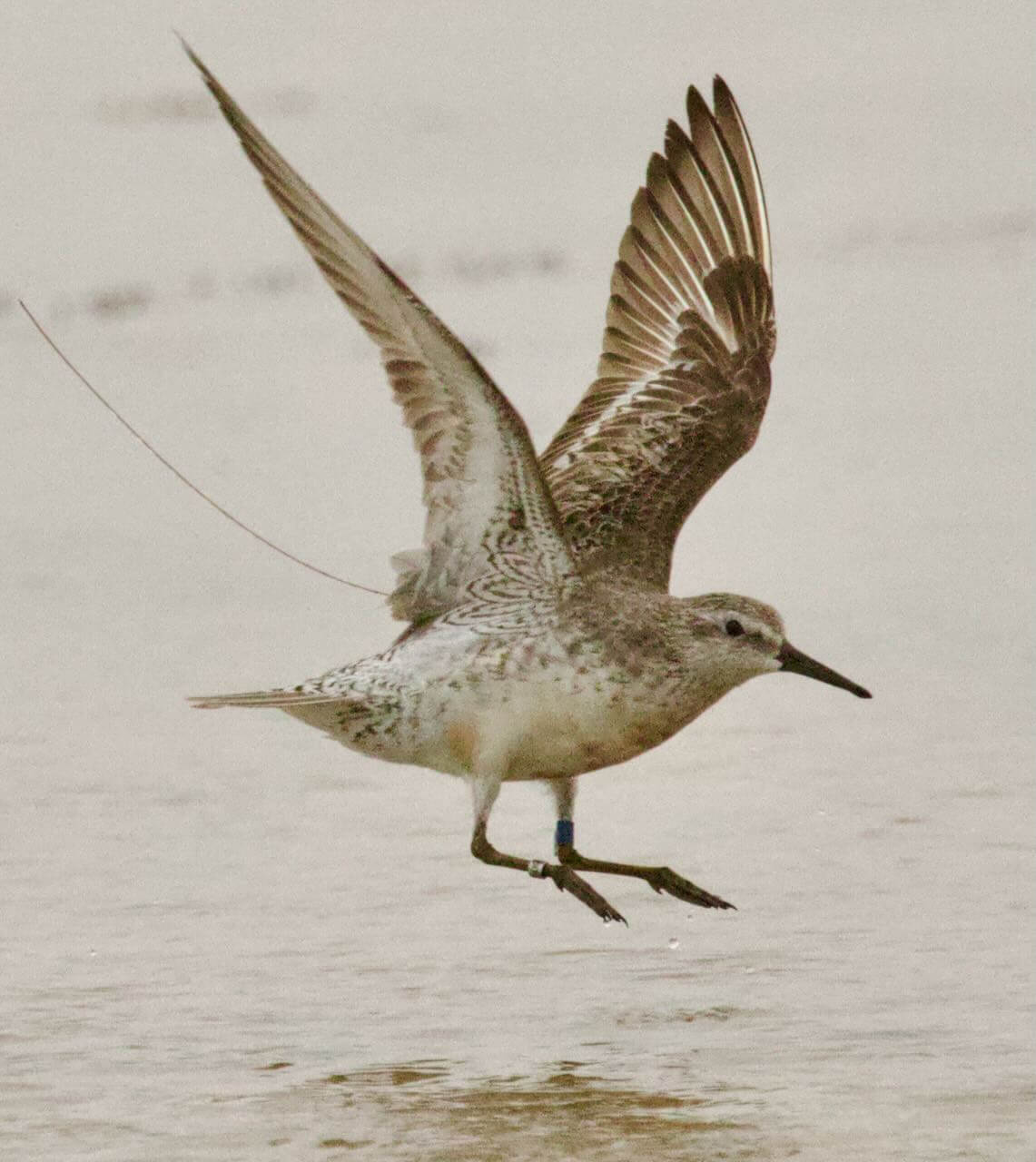
The Red Knot is a species of high conservation concern throughout the Western Hemisphere.
Photo: Larry Niles
Bahía Lomas, on the eastern end of the Strait of Magellan in Tierra del Fuego, is a highly important wintering site for rufa Red Knot in the Atlantic Flyway and a Western Hemisphere Shorebird Reserve Network site of hemispheric importance. Several proposed wind energy developments, which are linked to green hydrogen development, are sited in the immediate surroundings of the bay or along documented migratory corridors. Decisions made in the next several years about where these projects are permitted, sited, and operated will shape the trajectory of rufa Red Knot recovery for decades.
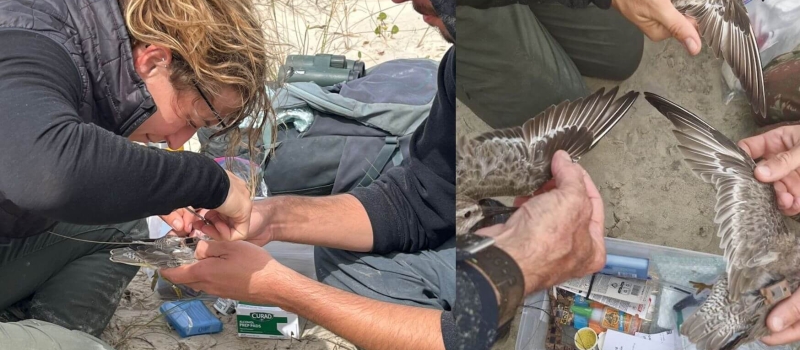
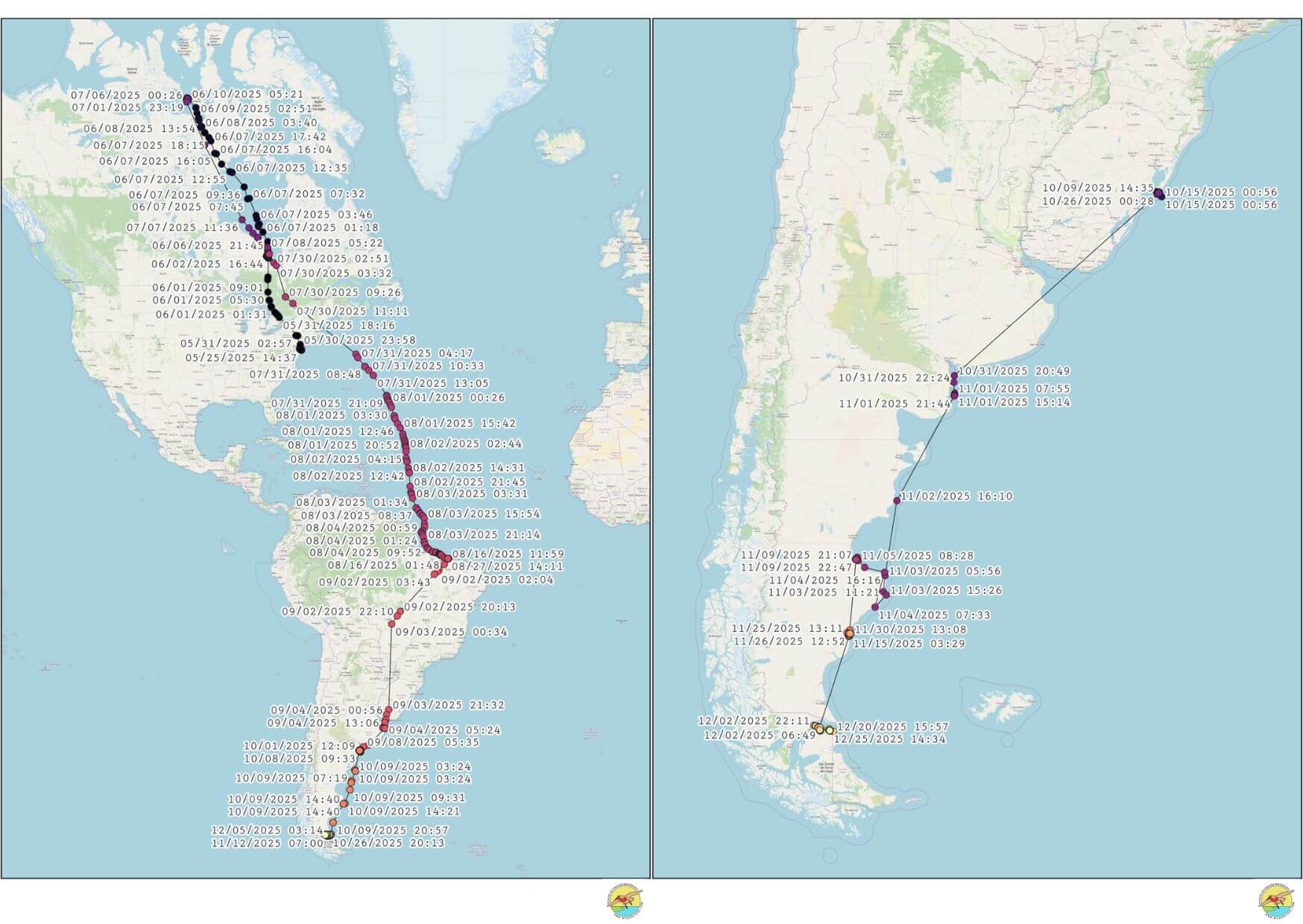
Dr. Larry Niles, a specialist at the WRP, says that “Tags are deployed on birds captured at major flyway stopover and wintering sites, including Delaware Bay (USA), the southeastern U.S. coast, and Brazil during both northbound and southbound migrations and transmit location data continuously throughout the annual cycle. The result is a high-resolution, individual-level record of migratory routes, stopover dynamics, habitat use, and connectivity between sites separated by more than 9,000 miles”.
Dr. Carmen Espoz, Director of the CBL, says: “These data are precisely the kind of evidence that environmental impact assessments for wind energy projects require. Until recently, however, this information has been unavailable for most shorebird species. They reveal not only which broad regions birds use, but also the specific flight paths, altitudes, timing, and habitat dependencies that determine where a turbine poses a meaningful risk of collision or displacement — and where it does not.” She adds: “We are also expanding data collection from the southern portion of the flyway. In January 2026, our team deployed transmitters on eight Red Knots, which are now beginning to provide valuable movement data.”
Since 2019, WRP has deployed more than 300 Argos satellite transmitters on Red Knots across the Atlantic Flyway, building one of the largest datasets of its kind for any small-bodied migratory shorebird.
Photo: Larry Niles
Diego Luna Quevedo, Policy and Governance Specialist at Manomet Conservation Sciences and the WHSRN Executive Office, stated that “These science-based partnerships aim to ensure that the clean energy transition does not come at the expense of biodiversity, by integrating science, policy, and collaboration to support informed decision-making around critical habitats and migratory pathways.For energy developers operating in ecologically sensitive and irreplaceable landscapes, partnering with scientific institutions that have proven, long-term expertise in local ecosystems and species is not optional, it is a prerequisite for credible, defensible, and ultimately successful project development.”
“Red Knots don’t recognize borders, and neither can the science needed to protect them,” said Stephanie Feigin, Ecologist at the WRP. “Sharing this kind of high-quality tracking data is essential if we want recovery to actually happen, and it gives decision-makers the kind of fine-scale, movement data they need to plan responsibly around critical shorebird habitat.”
WRP’s Atlantic Flyway tracking program has already produced findings on Delaware Bay stopover ecology, identified previously undocumented migratory connections between U.S. and South American sites, and refined estimates of habitat use at multiple key staging areas. The Bahía Lomas partnership extends that scientific footprint to the southern terminus of the flyway, closing a long-standing data gap at the site where the largest concentration of the rufa population over winters. Additional data-sharing agreements with research partners across the flyway are in development.
Additional data-sharing agreements with research partners across the flyway are in development.
Photo: Larry Niles