Bahía San Julián
Location
Province of Santa Cruz, Argentina
Category
Regional
Basis for Designation
More than 1% of the biogeographic population of three Patagonian shorebird species.
Significant Species
Magellanic Oystercatcher (Haematopus leucopodus)
American Oystercatcher (Haematopus palliatus)
Two-banded Plover (Anarhynchus falklandicus).
Size
43,428 acres
Date Designated
June 2026
Site Owner
Argentina’s National Parks Administration
Santa Cruz Provincial Agrarian Council
Site Partners
Asociación Ambiente Sur
Argentina’s National Parks Administration
Santa Cruz Provincial Agrarian Council
Municipality of Puerto San Julián
Universidad Nacional de la Patagonia Austral, Unidad Académica San Julián (UNPA-UASJ)
Overview
Bahía San Julián is located in the province of Santa Cruz, Argentina, and encompasses approximately 43,428 acres of coastal and marine habitats. The site includes sandy and muddy beaches, low cliffs, rocky shore platforms, gravel banks, extensive tidal flats, and saltmarshes, forming one of the most representative coastal systems along southern Patagonia. The bay extends between Cabo Curioso and Punta Desengaño and includes important intertidal and subtidal areas that support a rich diversity of marine wildlife and coastal birds.
The site includes the Important Bird Area (IBA SC16) and several protected areas under provincial and national jurisdiction. Part of the site lies within Makenke Interjurisdictional Marine Park, jointly managed by Argentina’s National Parks Administration and the Santa Cruz Provincial Agrarian Council. It also encompasses the San Julián Peninsula Provincial Reserve, the Bahía San Julián Special Protection Limited Use Area, the Isla Cormorán and Isla Justicia Special Protection Scientific Use Area, and La Cascada Urban Nature Reserve.

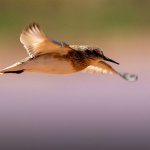
Photo by Ian Walker.
Importance for shorebirds
Bahía San Julián is a regionally important site for the conservation of both migratory and resident shorebirds. Its extensive intertidal flats provide essential feeding, resting, breeding, and migratory stopover habitat for numerous species throughout the year.
The site qualifies for designation as a WHSRN Regional Site by regularly supporting more than 1% of the biogeographic population of three Patagonian shorebird species: the Magellanic Oystercatcher (Haematopus leucopodus), with a maximum recorded count of 1,500 individuals; the American Oystercatcher (Haematopus palliatus), with 400 individuals; and the Two-banded Plover (Anarhynchus falklandicus), with 1,200 individuals. The bay is also regularly used by Nearctic migratory species, including the Hudsonian Godwit (Limosa haemastica), Red Knot (Calidris canutus rufa), Lesser Yellowlegs (Tringa flavipes), Greater Yellowlegs (Tringa melanoleuca), and Hudsonian Whimbrel (Numenius hudsonicus).
Shorebird monitoring conducted over recent years has strengthened knowledge of species abundance, distribution, and habitat use within the bay, providing valuable information to support conservation and site management.
Importance for other wildlife
The bay supports important breeding colonies of seabirds. Notably, it hosts Argentina’s largest colony of Red-legged Cormorants (Poikilocarbo gaimardi), with approximately 900 breeding pairs, as well as a colony of more than 44,000 pairs of Magellanic Penguins (Spheniscus magellanicus) on Isla Cormorán. Other breeding species include the Imperial Cormorant (Leucocarbo atriceps), Magellanic Cormorant (Leucocarbo magellanicus), Neotropic Cormorant (Nannopterum brasilianum), Chilean Skua (Stercorarius chilensis), Dolphin Gull (Leucophaeus scoresbii), and South American Tern (Sterna hirundinacea).
Marine wildlife includes populations of Commerson’s Dolphin (Cephalorhynchus commersonii), South American Sea Lion (Otaria flavescens), Southern Right Whale (Eubalaena australis), and Peale’s Dolphin (Lagenorhynchus australis), the latter two protected as Provincial Natural Monuments. The bay is also an important area for the Broadnose Sevengill Shark (Notorynchus cepedianus), a species currently classified as Vulnerable.

Photo by Mauro Ricci.
Local community
The city of Puerto San Julián, located on the northern shore of the bay, is home to approximately 20,000 residents and maintains a close relationship with the coastal ecosystem. Key activities associated with the area include artisanal and recreational fishing, recreational boating, and port operations that support commercial fisheries.
In recent years, a variety of environmental education, science outreach, and community engagement initiatives have been developed to strengthen awareness and appreciation of local biodiversity. Universities, civil society organizations, local authorities, and protected area managers have organized workshops, exhibitions, and community events that promote the conservation of shorebirds and coastal ecosystems.

Photo by Ian Walker.
Threats and site management
The main threats to the conservation of Bahía San Julián include solid waste pollution from a nearby landfill, untreated wastewater discharges, free-ranging dogs associated with human activities, and off-road vehicle traffic in sensitive coastal habitats. Other potential threats include incidental catch in fisheries, increasing recreational activities without adequate regulation, coastal infrastructure development, and the impacts of climate change, particularly sea-level rise.
Makenke Interjurisdictional Marine Park has an active management plan, dedicated technical staff, and resources for site management. However, other protected areas within the site face operational and funding constraints. An interinstitutional governance initiative is currently being strengthened to improve coordination among government agencies, civil society organizations, academic institutions, and local stakeholders, with the goal of ensuring the integrated management of Bahía San Julián and the conservation of its shorebirds.